

Example payloads
The following examples show the structure of thesession_closed payloads for visitor and account events.
Visitor event payload
Account event payload
Payload reference
There are two webhook action types, which share the same envelope but differ in whatdata contains:
- Visitor event: the full session, visitor, and account details
- Account event: the company account details only
estimatedAnnualRevenue) are sent as strings.
Top-level envelope
data.session: the demo session
Fields common to all sessions:
Additional fields for interactive demo sessions (
type: INTERACTIVE_DEMO):
session.presentation identifies sessions that came through a presentation, not how the
presentation was created. Presentations can be started from the in-app modal or from Launchpad,
and the field does not distinguish between the two.Avoid using visitorOpportunityId as a session origin signal. That property lives on the
visitor record and persists until a newer value replaces it, so every session after a single
Launchpad touch carries the opportunity ID forward regardless of how the session actually
started.type: AGENT_DEMO):
data.endUser: the visitor
data.companyAccount: the account
null on visitor events when no account could be matched (or account info is unavailable for the visitor). This object is the entire data payload for account events.
Custom property values
Each entry inendUser.customPropertyValues and companyAccount.customPropertyValues:
Recorded events
Each entry insession.recordedEvents (and mirrored in endUser.recordedEvents) is one activity event from the session:
Request headers
Testing
A free service like webhook.site can be an easy way to get started and test the Webhook integration.Webhook.site is a public webhook testing service, so it is recommended only to send test data when
using this, as you could inadvertently expose customer event data.
Opportunity owner fields
When a Launchpad presentation is connected to a Salesforce opportunity, the webhook payload includes two additional fields for the opportunity owner:
These fields let you route webhook events to the right rep. For example, trigger a Slack notification or Zapier workflow that notifies the opportunity owner when their prospect views a demo.
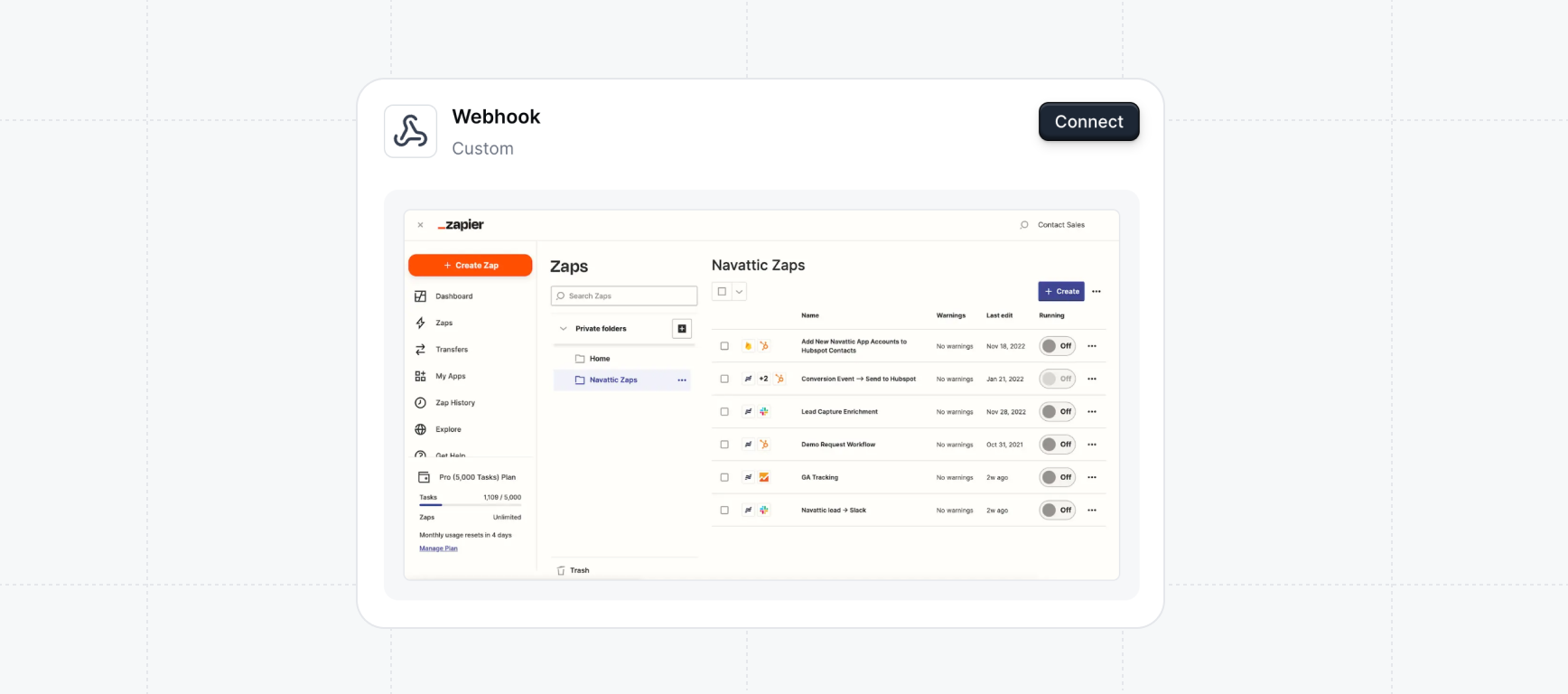
Send data to Zapier using Webhook
Sending webhook events to Zapier allows you further filter and format the data within Zapier before sending it to additional destinations like Google Sheets, Gmail, Notion, or more. This setup demo includes all the steps you need to send data from Navattic to Zapier.Use the Webhook integration to integrate with a Zapier workflow using a Zap URL. Learn more about
triggering Zaps from
webhooks.