

Overview
The Navattic Salesforce integration connects to your Salesforce instance through Salesforce’s standard OAuth flow. It uses standard objects and custom fields.Salesforce Configuration
Custom Object: Navattic Session
When connecting Salesforce to Navattic, you have the option to create a custom object called Navattic Session to track individual demo viewing sessions. This object includes:Session Data Fields
Session Data Fields
- Session ID (text, primary field)
- Started At (datetime)
- Full Name (text, 255 characters)
- Email (text, 255 characters)
- Duration (minutes) (number with 3 decimal places)
- Steps Viewed (whole number)
- Demos (text, 255 characters)
- Flows (text, 255 characters)
- Very Interested Areas (text, 255 characters)
- Somewhat Interested Areas (text, 255 characters)
- Not Interested Areas (text, 255 characters)
- Opportunity (lookup to Opportunity)
- Account (lookup to Account)
- Contact (lookup to Contact)
- Lead (lookup to Lead)
Integration User Requirements
The Salesforce user account that connects to Navattic needs specific permissions to sync demo engagement data.Required Object Permissions
Required Object Permissions
The connected user must have Read and Edit access to:
- Lead object
- Contact object
- Account object
- Opportunity object
- Navattic Session object (custom)
Required Field-Level Security
Required Field-Level Security
Field-Level Security (FLS) is separate from the object-level Edit permission in the permission set: you can grant object-level Edit while keeping FLS scoped to only the fields Navattic touches.Always required (Read and Edit):
- Email (on Lead and Contact)
- LastName (on Lead and Contact)
- All Navattic custom fields
- Name (on Account): only if account creation is enabled, or if the default Company Name field mapping is kept
- Website (on Account): only if account creation is enabled, or if the default Company Domain field mapping is kept
- FirstName (on Lead and Contact): only if the default FirstName field mapping is kept
- Company (on Lead): only if lead creation is enabled
- Name (on Opportunity): the integration reads but never writes to Opportunity records
Required System Permissions
Required System Permissions
- API Enabled - This permission must be enabled on the user’s profile or permission set
- View All Data (recommended) - Makes setup easier, though not strictly required
- Modify All Data (recommended) - Makes setup easier, though not strictly required
Permission Set Creation
Permission Set Creation
During the initial connection, Navattic automatically creates a Permission Set that grants access to:
- The Navattic Session custom object
- All fields on the Navattic Session object
- Full CRUD permissions on Lead, Contact, Account, and Opportunity objects
User Account Recommendations
User Account Recommendations
Option 1: Dedicated Integration User (Recommended)Create a dedicated Salesforce user specifically for the Navattic integration:
- Clear audit trail of all Navattic activities
- Easy to troubleshoot permission issues
- Can be disabled without affecting other integrations
- Doesn’t consume a regular user license (use Integration User license if available)
- Create a new user with Integration User or regular license
- Assign a profile with API Enabled permission
- Grant the required object and field permissions
- Use this user to connect Navattic
- Quick setup with no permission configuration needed
- Guaranteed to have all required permissions
- Less clear audit trail
- All Navattic actions appear as admin actions
- If admin leaves organization, integration may break
Setup Steps
1
Connect to Salesforce
In Navattic, navigate to Integrations > Salesforce and click Connect.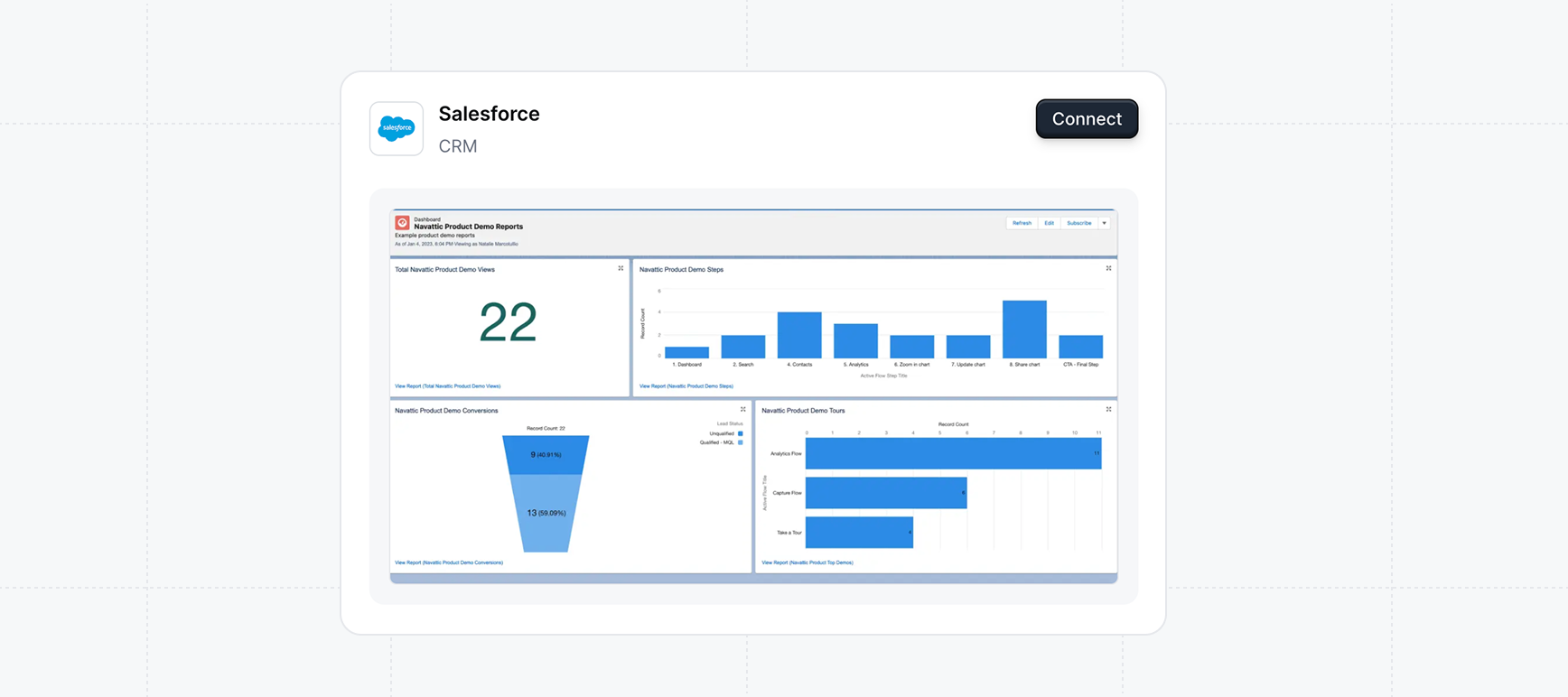
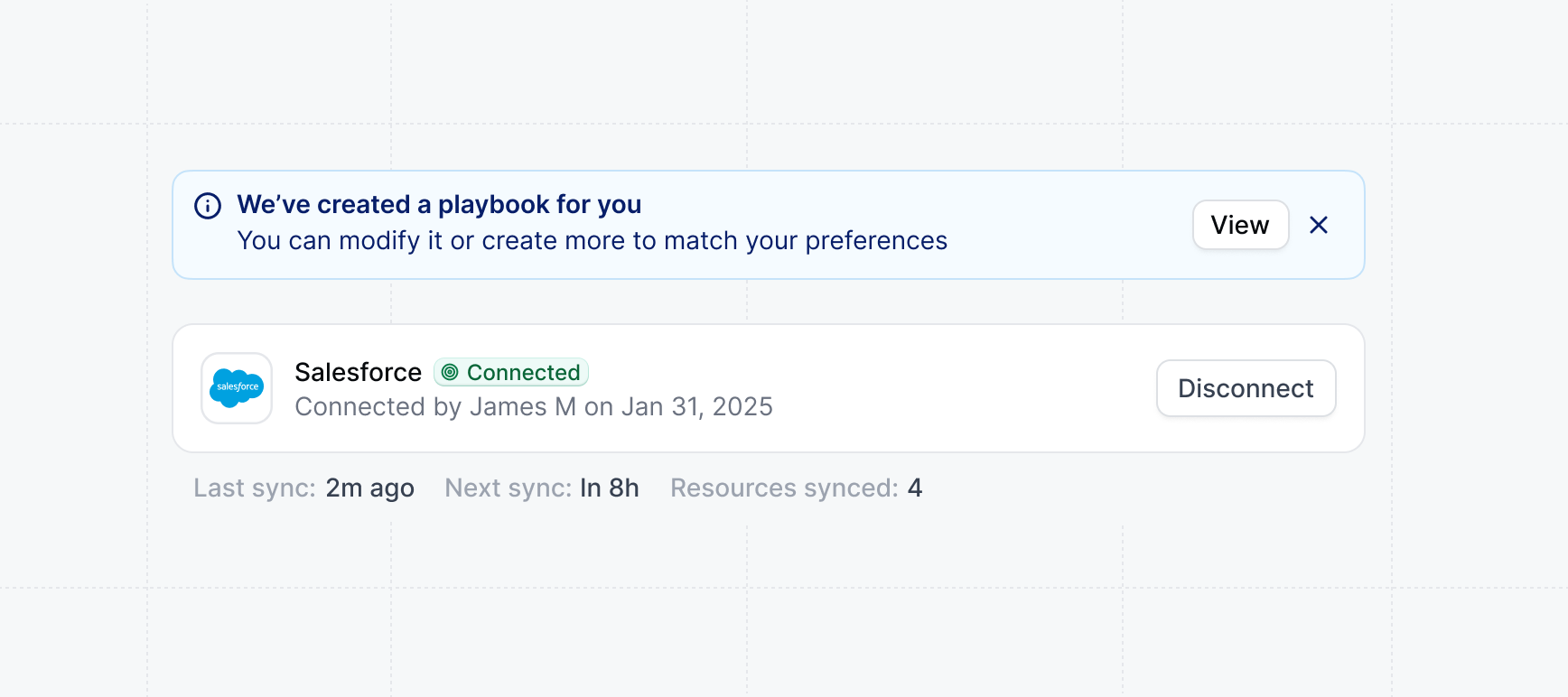
- Production for your live Salesforce instance
- Sandbox for testing in a Salesforce sandbox environment
Playbook will be automatically created to send engagement data from demos to your Salesforce Opportunity, Leads, Contact, and Accounts.You can click view to manage the Playbook or refine the Audience filters.2
Review Custom Fields
After connecting, Navattic automatically creates the custom fields on your Salesforce objects. You can verify these were created by:
- In Salesforce Setup, go to Object Manager
- Select Lead, Contact, Account, or Opportunity
- Click Fields & Relationships
- Look for fields starting with “Navattic_”
3
Edit your Salesforce Object page
Navigate to your Salesforce object page that you’d like to edit (Opportunity, Lead, Contact, or Account). Select 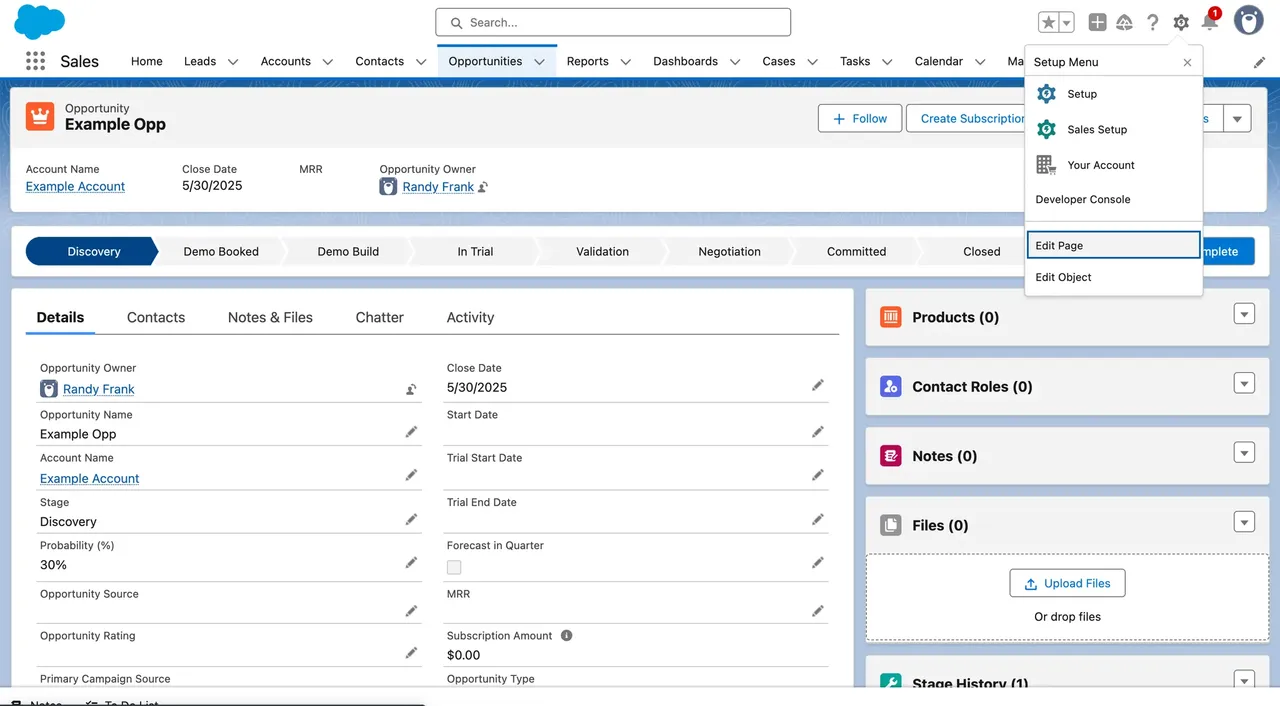
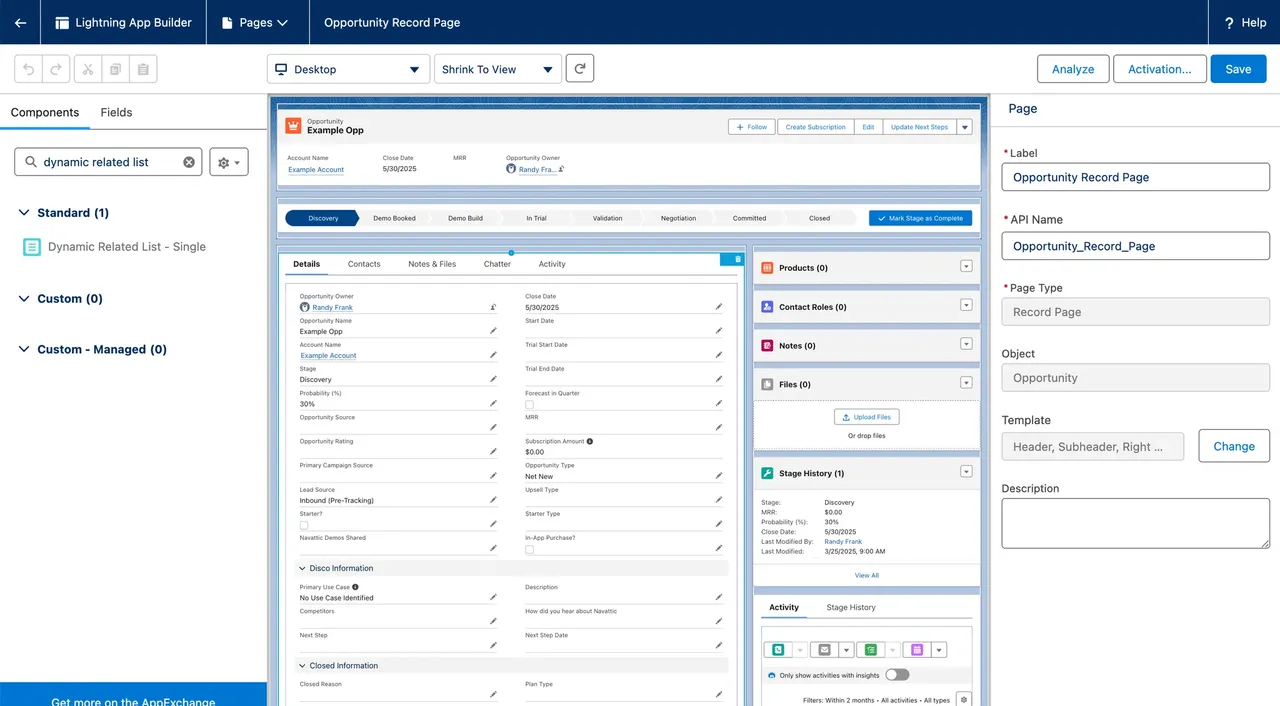
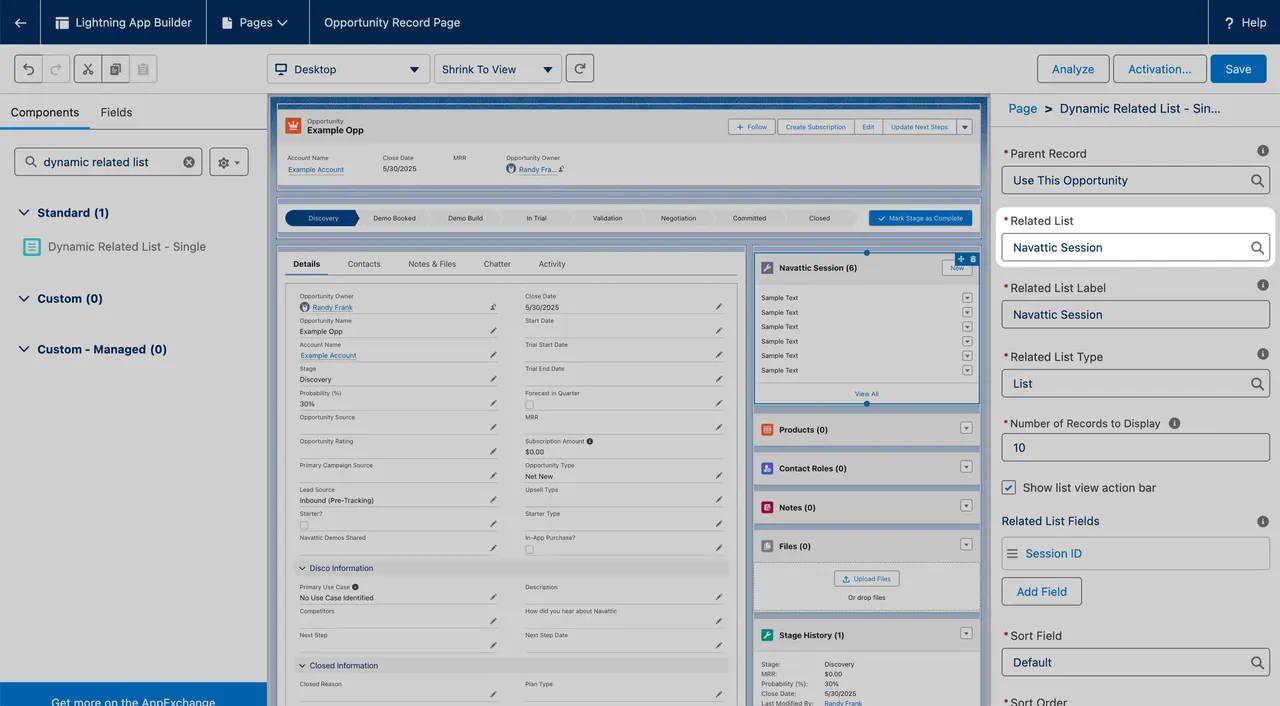
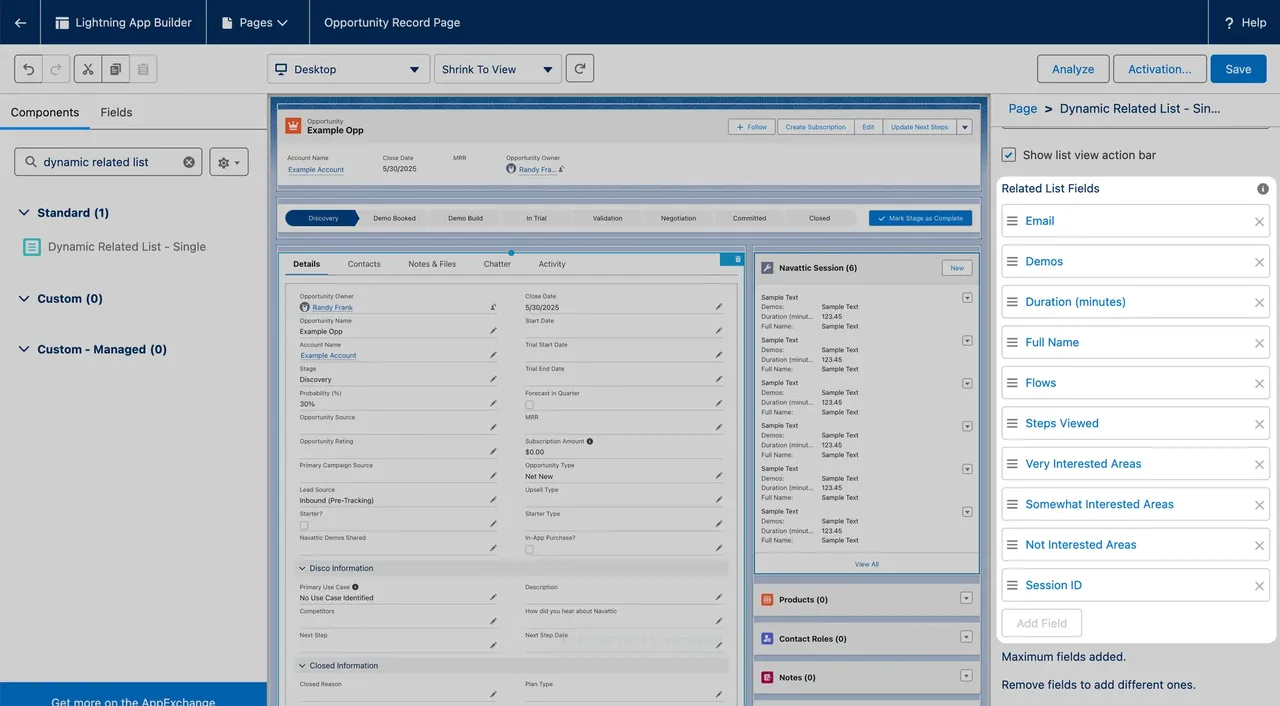

Edit Page under the Setup Menu.Dynamic Related List - Single in the Components search field.Navattic Session in the Related List field. Make sure that the Parent Record is set to the default Use This Opportunity (or the relevant Salesforce object).Related List Fields to show the following fields:- Demos
- Duration (minutes)
- Full Name
- Flows
- Steps Viewed
- Very Interested Areas
- Somewhat Interested Areas
- Not Interested Areas
- Session ID
4
Configure Field Mappings
Go to the Salesforce integration settings in Navattic and set up field mappings to control which engagement data syncs to which Salesforce fields.See Field Mappings for detailed configuration options.
5
Set Up Playbooks
Create Playbooks to define when and how demo engagement data should sync to Salesforce.See Salesforce Integration for complete setup instructions.
Opportunity owner data
When a presentation is connected to a Salesforce opportunity, Navattic automatically looks up the opportunity owner. It stores the owner’s details as custom properties on the session.
These values are populated automatically. No additional configuration is required. They are included in webhook payloads and can be used in downstream workflows, such as routing notifications to the rep who owns the deal.
Opportunity owner data is only populated when a presentation share link has a Salesforce opportunity connected. See Present demos for instructions on connecting an opportunity to a share link.
Field guide: viewing Navattic sessions in Salesforce
After your admin completes the setup above, Navattic automatically logs every demo session from your share links as a Navattic Session record in Salesforce. No manual data entry is required.Connect your share links to opportunities
Sessions only appear on an opportunity when your share link is connected to one at the time you create it. Without that connection, session data is still captured but won’t surface on the opportunity record. To connect a share link to an opportunity:- When sharing a demo through Launchpad, see Sharing demos for step-by-step instructions.
- When creating a presentation for a live call, see Present demos.
Find session data on the opportunity
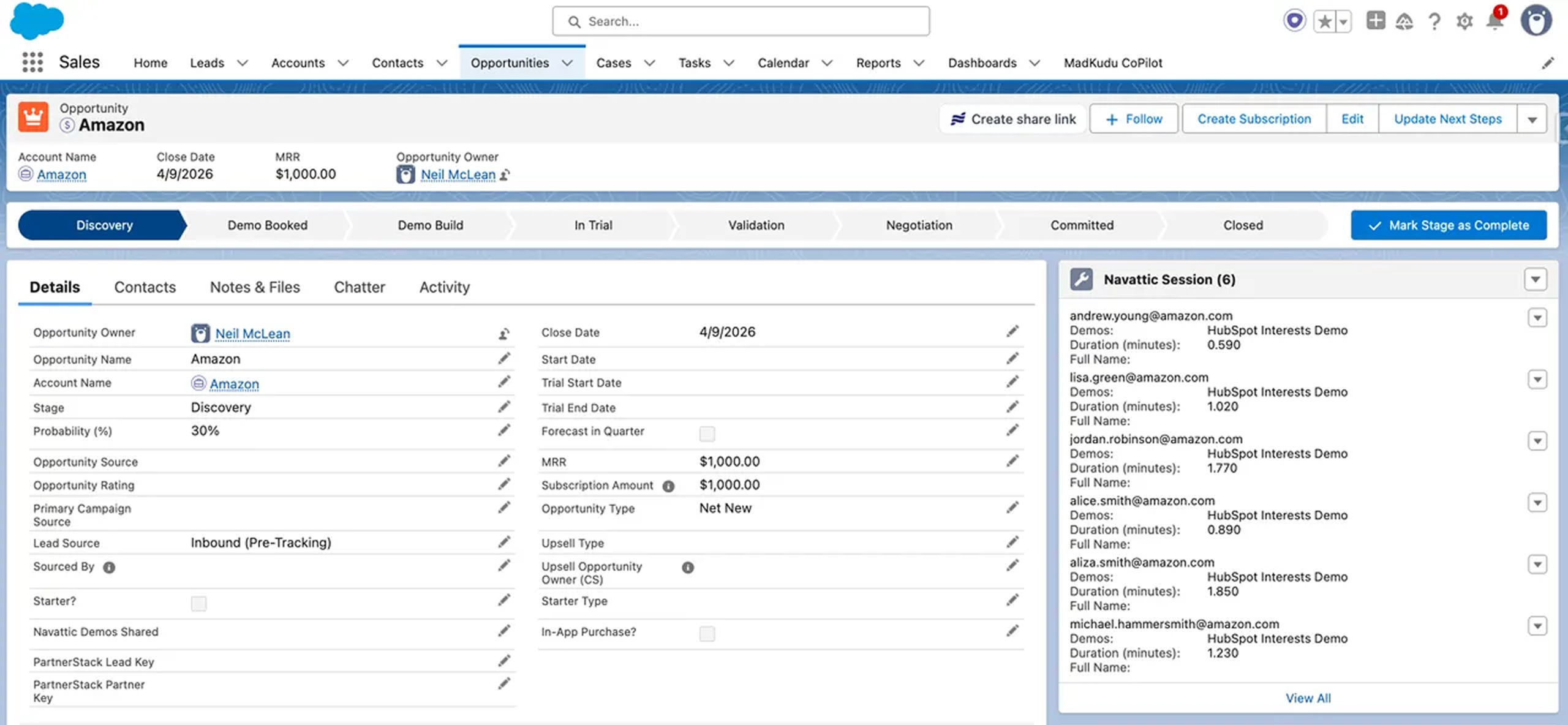
Once a prospect views your demo, open the Opportunity record in Salesforce and scroll to the Navattic Sessions related list. Each row represents one individual viewing session, so if three people at the same account watch the demo, you’ll see three separate rows.How to read each field
Plays to run
Pre-call prep: lead with what matters
Pre-call prep: lead with what matters
Before any follow-up call, open the Navattic Sessions related list on the opportunity and note the Very Interested Areas for each viewer. Structure your agenda around those topics first: your prospect has already told you what they care about.Check Not Interested Areas so you know what to skip. Spending time on areas a prospect explicitly deprioritized can stall momentum.
Spot new stakeholders
Spot new stakeholders
If you see a Full Name or Email you don’t recognize, the demo was likely forwarded internally. That’s a buying signal: someone on your contact’s team is doing their own research.Add that person as a contact on the opportunity and reach out directly. Multithreading early reduces the risk of a single point of failure in the deal.
Time your follow-up
Time your follow-up
Use the Started At field to follow up while the demo is still fresh. A same-day or next-day message referencing what the prospect explored tends to get a much higher response rate than a generic check-in.See When to share demos for more guidance on timing your outreach.
Re-engage stalled deals
Re-engage stalled deals
If an opportunity has gone quiet and you see no new sessions in the past two weeks, it’s a good time to re-engage. Create a fresh share link focused specifically on the prospect’s Very Interested Areas from their last session, and send it with a short, personalized note.A targeted demo link gives the prospect a low-friction reason to re-engage without requiring them to join a call.
If the Navattic Sessions related list isn’t visible on your opportunity records, ask your Salesforce admin to add it by following the setup steps on this page.
Troubleshooting
Connection Fails with “Insufficient Permissions”
Cause: The Salesforce user doesn’t have API Enabled permission. Solution:- Go to Salesforce Setup > Users > Profiles
- Find the user’s profile and edit it
- Ensure “API Enabled” is checked under System Permissions
- Save and retry the connection
Custom Fields Not Created
Cause: The user may lack Modify Metadata permission or field creation is restricted. Solution:- Use a System Administrator account to connect initially
- Custom fields will be created automatically
- You can then adjust permissions and reconnect with a different user if needed
Data Not Syncing to Salesforce
Cause: Field-level security may be preventing writes to custom fields. Solution:- Go to Salesforce Setup > Object Manager
- Select the affected object (Lead, Contact, Account, or Opportunity)
- Click Fields & Relationships
- For each Navattic custom field, click the field name
- Click “Set Field-Level Security”
- Ensure the integration user’s profile has “Visible” and “Editable” checked
- Save changes
”Record Locked” or “Unable to Lock Row” Errors
Cause: Salesforce record locking during high-volume updates. Solution:- These errors are typically temporary and Navattic will retry
- If persistent, check for workflow rules or validation rules that may be causing conflicts
- Consider adjusting the timing of your Playbook triggers to spread out updates
Permission Set Assignment Fails
Cause: User already has maximum number of permission set assignments. Solution:- In Salesforce Setup, go to Users > Permission Sets
- Find “Navattic Permission Set”
- Manually assign it to the integration user
- Or consolidate other permission sets if the user has reached the limit
Security Considerations
OAuth Token Storage
Navattic stores OAuth tokens securely and uses them only to sync data according to your configured Playbooks. Tokens are:- Encrypted at rest
- Only used for authorized API operations
- Automatically refreshed when needed
- Revocable at any time from Salesforce
Data Access
The integration only:- Reads data needed to match visitors to Leads/Contacts
- Writes engagement data to fields you’ve mapped
- Never modifies other Salesforce data
- Respects your Salesforce sharing rules and permissions
Disconnecting the Integration
To disconnect Navattic from Salesforce:- In Navattic: Go to Integrations > Salesforce, open the connection card menu, and click Disconnect
- In Salesforce: Go to Setup > Connected Apps OAuth Usage to view and revoke the connection